About This Tour
This walk follows Gdańsk’s historic Royal Route through the heart of the Main Town and down to the Motława River. The route brings together ceremonial gates, grand civic buildings, merchant meeting places, and richly decorated streets that reflect the city’s former wealth and independence. Along the way, travelers encounter Renaissance and Mannerist architecture, Gothic churches, and reminders of daily life in an important Baltic port. The atmosphere shifts from formal and monumental near Long Lane and the Long Market to working waterfront scenes by medieval cranes and water gates. The experience combines political history, trade, religion, and urban life in a compact and walkable area.
- Duration
- 45m
- Distance
- 2.5 km
- Stops
- 22 locations
- Languages
- 9 languages


Updated 2026-02-19
Interactive Map
Tour Stops (22)
Stop 1: Highland Gate (Brama Wyżynna)
The ceremonial entrance to Gdańsk’s Royal Route - a Renaissance gate packed with coats of arms, lions, and sharp Latin mottoes.
Stop 2: Court of St. George's Brotherhood (Dwór Bractwa św. Jerzego)
Late-Gothic hall of Gdańsk’s elite St. George rifle brotherhood - look up for the 1566 St. George-and-dragon statue.
Stop 3: Golden Gate (Brama Złota)
Gdańsk’s showpiece gateway to Long Lane - Dutch Mannerist stonework, civic virtues above, and a motto about unity and power.
Stop 4: Uphagen's House on Długa Street (Dom Uphagena)
Step into an 18th-century Gdańsk townhouse on the Royal Route - a rare peek at bourgeois life, from the grand salon to the hidden kitchen wing.
Stop 5: Main Town Hall (Ratusz Głównego Miasta)
Gdańsk’s power center on the Royal Route - climb your eyes up the 83-meter tower, then imagine the Red Room where the city’s fate was debated.
Stop 6: Neptune’s Fountain and Artus Court (Fontanna Neptuna i Dwór Artusa)
Gdańsk’s postcard view - Neptune guarding the Long Market, with Artus Court behind him, the old meeting place of merchants and brotherhoods.
Stop 7: Fahrenheit Meteorological Column (Kolumna meteorologiczna Fahrenheita)
A street-side thermometer and barometer on Długi Targ - a modern replica inspired by an 18th-century device, honoring Gdańsk-born Daniel Fahrenheit.
Stop 8: Green Gate (Zielona Brama)
The grand “water gate” at the end of Długi Targ - built for Polish monarchs, inspired by Antwerp, and now a National Museum exhibition space.
Stop 9: Chlebnicka Gate (Brama Chlebnicka)
A late-Gothic water gate on the Motława - the oldest surviving of its kind in Gdańsk, linking the riverwalk to the historic Chlebnicka Street.
Stop 10: St. Mary’s Gate (Brama Mariacka)
A late-Gothic water gate on the Motława - rebuilt after WWII, and the dramatic entrance to Mariacka Street.
Stop 11: Holy Spirit Gate (Brama Świętego Ducha)
A historic water gate on the Motława - linking the riverwalk to Świętego Ducha Street near St. Mary’s and the Royal Chapel.
Stop 12: Gdańsk Crane (Stary Żuraw Portowy - Żuraw nad Motławą)
Gdańsk’s medieval port crane and water gate - a brick-and-wood giant where human-powered treadwheels once lifted cargo from ships.
Stop 13: Nova Civitas - Nowe Miasto (Dzielnica Świętojańska)
A historic “New Town” district by the Motława - built on wet ground, shaped by merchants, and anchored by St. John’s Church.
Stop 14: Four Quarters Fountain (Fontanna Czterech Kwartałów)
A modern fountain with four lions and colored light, marking where Gdańsk’s historic “quarters” once met - right by the Royal Chapel.
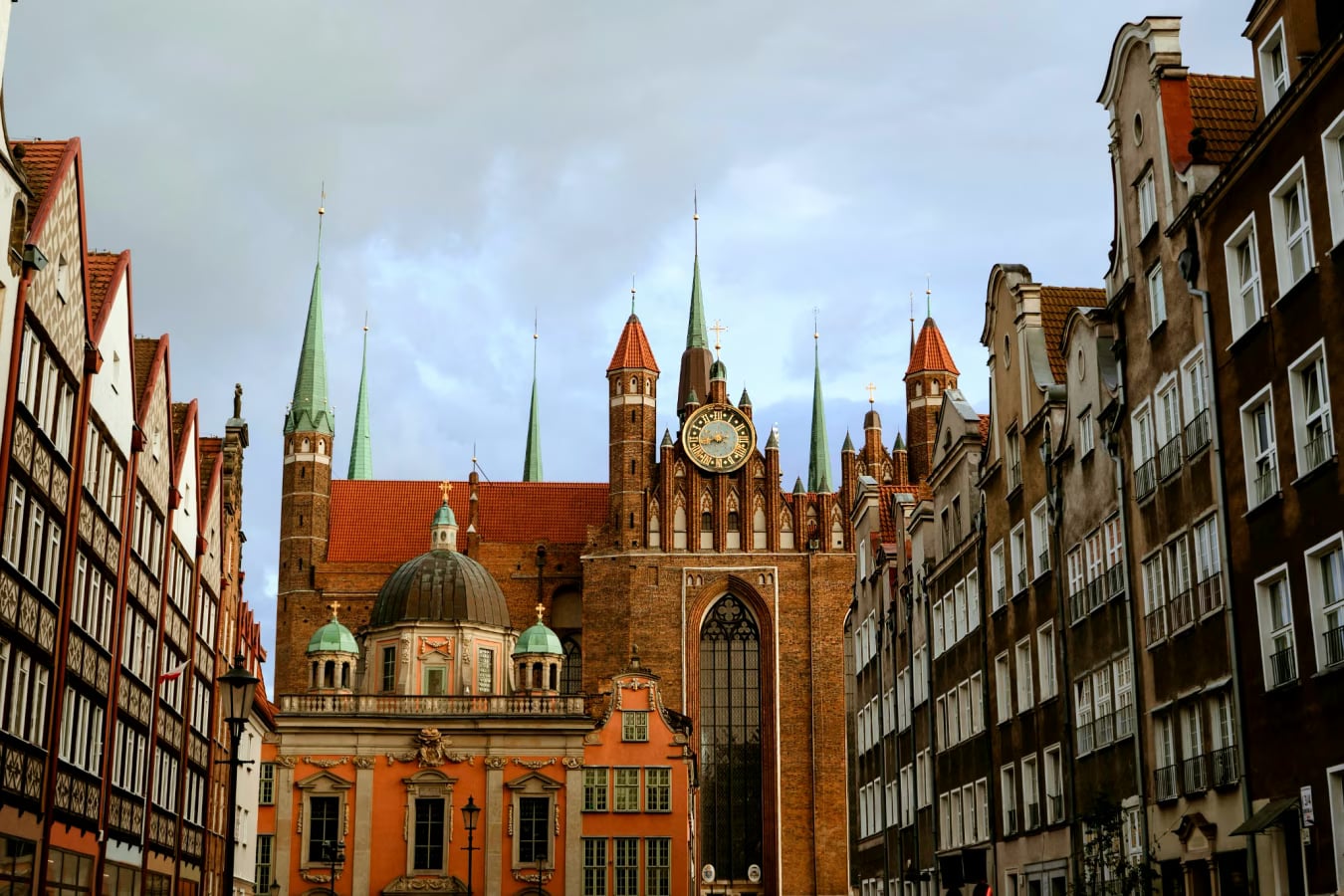
Stop 15: Royal Chapel (Kaplica Królewska)
Gdańsk’s only Baroque church in the Main Town - built in 1678-1681 for local Catholics, with a dome that peeks above the tight medieval streets.
Stop 16: St. Mary’s Church (Bazylika Mariacka Wniebowzięcia Najświętszej Maryi Panny)
A giant Gothic basilica of brick - one of the largest churches in Europe, with a famous medieval astronomical clock and a tower view over Gdańsk.
Stop 17: Piwna Street (ul. Piwna)
“Beer Street” beside St. Mary’s - once linked to famous Jope beer, now one of the liveliest lanes in the Main Town.
Stop 18: Mannerist Facade of the Great Armoury (Wielka Zbrojownia)
A Dutch-Mannerist showpiece from 1600-1605 - an arsenal dressed like a palace, with gables, turrets, cannonballs, and Minerva.
Stop 19: Lighthouse Tower (Baszta Latarniana)
A mid-14th-century defensive tower - the oldest surviving tower of medieval Gdańsk’s walls, with rows of loopholes still visible.
Stop 20: Old “Pharmacy” (Stara Apteka)
A 1636 “Old Pharmacy” that never sold medicine - it made gunpowder and cannon ammo, and now hides an intimate theater space.
Stop 21: Wybrzeże Theatre (Teatr Wybrzeże)
Gdańsk’s flagship drama theatre - a postwar institution on Targ Węglowy, built on layers of older stages and rebuilt city history.
Stop 22: Coal Market Square (Targ Węglowy)
A historic trading square turned city stage - framed by the Golden Gate, the Great Armoury, and Gdańsk’s main theatre.
Tips & Recommendations
- Start early in the morning to enjoy the Royal Route before large tour groups arrive.
- Wear comfortable walking shoes, as most streets are cobblestone.
- Many historic interiors have limited opening hours, so check times in advance.
- Church visits may require modest clothing, with shoulders covered.
- Climbing church towers involves narrow stairs and is best for those comfortable with heights.
- The waterfront area can be windy and cooler than the streets inland.
- Cafés around the Long Market are scenic but more expensive than nearby side streets.
- Allow extra time if visiting during summer festivals or holiday weekends.