About This Tour
This walking tour follows Warsaw’s Old Town from Castle Square into the tight lanes behind the Royal Castle, then onward to the city walls, the Barbican, and the Old Town Market Square - before returning to Castle Square for a final pause. Along the way, the route connects Warsaw’s grand symbols with small surprises: monuments to key figures, a cheerful chiming zodiac clock hidden in plain sight, a bronze model of the Old Town, and corners where street names still echo everyday medieval work. The main thread is Warsaw’s remarkable rebuilding. Several stops focus on what was lost in 1944 and how the Old Town was reconstructed after the war - not as a simple repair, but as a careful re-creation of streets, facades, and landmarks. Memorials and plaques add a human layer, from child messengers of the Warsaw Uprising to the people who led the postwar restoration. The tour also leaves space for lighter stories. There is the legendary Warsaw Mermaid in the Market Square, the wishing bell on Kanonia, the mysterious “Jesuit bear” by the Church of Our Lady of Grace, and the viewpoint at Gnojna Góra above the Vistula with the Siłacz strong man carrying his boulder. It is a route designed to feel like the Old Town itself: historic, rebuilt, and full of details that reward slow steps.
- Duration
- 45m
- Distance
- 1.6 km
- Stops
- 21 locations
- Languages
- 9 languages


Updated 2026-01-17
Interactive Map
Tour Stops (21)
Stop 1: The Royal Castle in Warsaw
Warsaw’s Royal Castle - royal residence, parliament landmark, wartime ruin, and faithful postwar reconstruction, now a museum with masterpieces inside.
Stop 2: Sigismund's Column (Kolumna Zygmunta III Wazy) - Castle Square
Warsaw’s iconic 1644 column on Castle Square, honoring Sigismund III Vasa - the king who moved Poland’s capital to Warsaw, rebuilt after WWII.
Stop 3: Jan Zachwatowicz Memorial Statue
Bronze statue by the Old Town walls near Castle Square, honoring Jan Zachwatowicz - the key figure behind Warsaw’s postwar rebuilding.
Stop 4: Jan Kiliński Monument (Pomnik Jana Kilińskiego)
Raised-sabre statue of shoemaker-turned-rebel Jan Kiliński, with a nearby bronze Old Town model revealing Warsaw’s walls and streets.
Stop 5: Sigismund's Clock (Zegar Zygmunta)
A hidden Old Town gem: a zodiac-ring wall clock near the Jan Kiliński Monument that chimes with a cheerful tune close to Castle Square.
Stop 6: Mały Powstaniec Monument (Pomnik Małego Powstańca)
A small bronze boy in an oversized helmet by Warsaw’s Old Town walls, memorializing the child messengers and fighters of the 1944 Warsaw Uprising.
Stop 7: Warsaw Barbican (Barbakan Warszawski)
A red-brick defensive gateway between Warsaw’s Old Town and New Town - rebuilt after WWII, and still showing how the city once protected its gates.
Stop 8: The Old Spring of Szeroki Dunaj
A historic 19th-century cast-iron water pump on Szeroki Dunaj, marking an old spring and stream - and the busy, tragic history of Warsaw’s Old Town.
Stop 9: Wąski Dunaj Street
A tiny Old Town lane named after a lost stream, rebuilt after 1944, linking the Market Square area to Podwale by Warsaw’s historic walls.
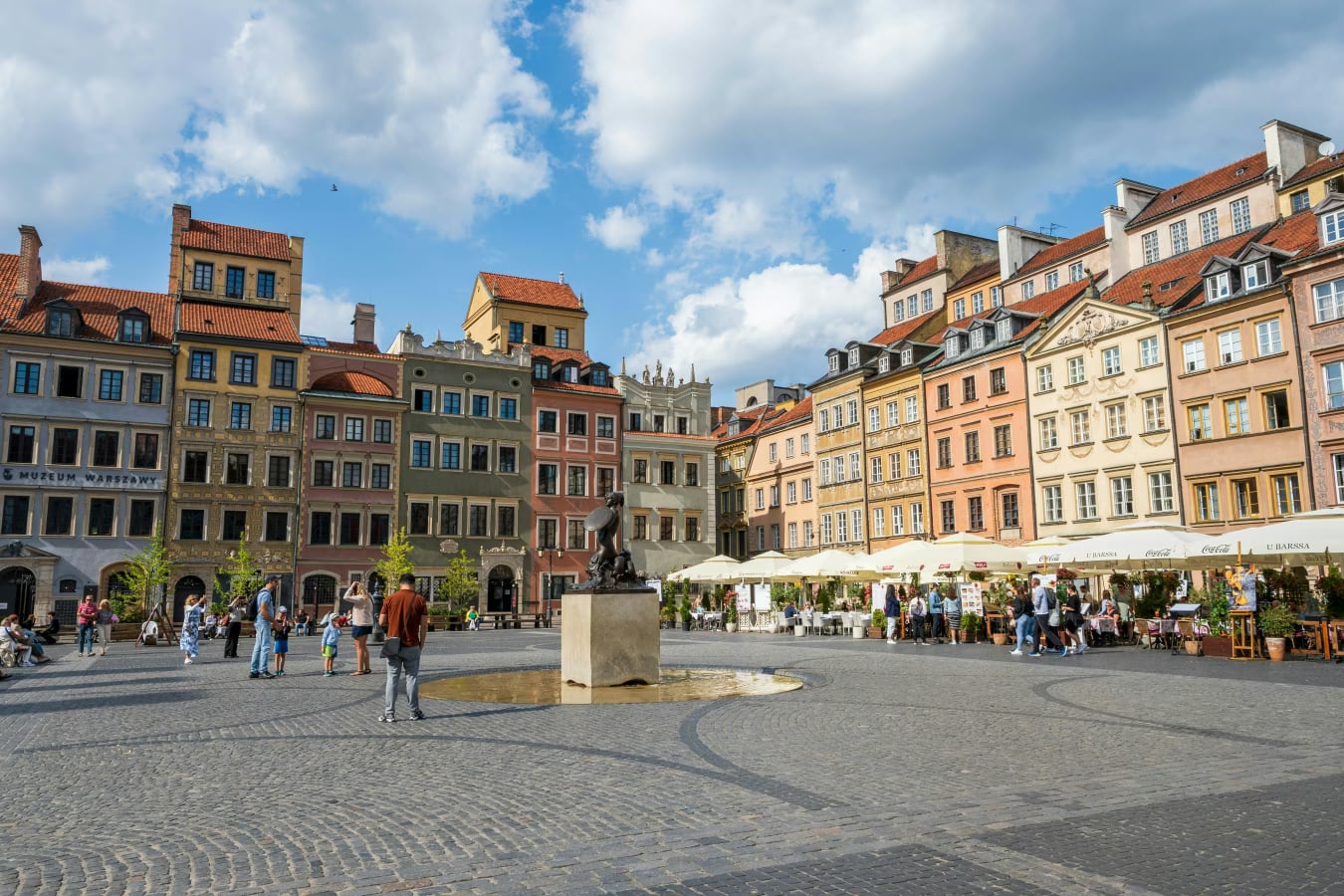
Stop 10: Old Town Market Square (Rynek Starego Miasta)
Warsaw’s oldest square - rebuilt after 1944, crowned by the Mermaid statue, and surrounded by reconstructed townhouses that keep the Old Town’s story alive.
Stop 11: Warsaw Mermaid Statue (Syrenka Warszawska)
Warsaw’s iconic mermaid with sword and shield, guarding Old Town Market Square and carrying a legend of protection.
Stop 12: Historic Townhouses of Old Town Market Square
Four named townhouses on Warsaw’s Old Town Market Square - Pod Fortuną, Falkiewiczowska, Kozubowska, and Orlemusowska - rebuilt history in color.
Stop 13: Gnojna Góra Viewpoint and the Siłacz Strong Man
Gnojna Góra viewpoint above the Vistula, shaped by centuries of Old Town waste, with the Siłacz Strong Man statue carrying a boulder.
Stop 14: The Bell on Kanonia Square (Dzwon na Kanonii)
A cracked bell cast in Warsaw in 1646, displayed on Kanonia Square and famous for the local wishing ritual.
Stop 15: The Covered Royal Walkway (Kryty Ganek Królowej Anny)
A covered passage over Kanonia, built for Queen Anna and remembered for the 1620 attack on King Sigismund III Vasa.
Stop 16: Archcathedral Basilica of St John the Baptist
Warsaw’s Old Town cathedral, rebuilt after 1944, with historic crypts and a nearby narrow lane that reveals a beautiful, quiet view.
Stop 17: The Jesuit Bear by the Church of Our Lady of Grace
A small stone “bear” outside the Church of Our Lady of Grace - a mid-18th-century sculpture with a saintly puzzle and a Warsaw love legend.
Stop 18: Old Post Office and Reconstruction Plaque
Old Post Office townhouse on Warsaw’s Old Town Market Square, with a plaque remembering the 1944 destruction and the 1951-1953 reconstruction.
Stop 19: Piwna, Zapiecek, and Piekarska Crossroads
A telling Old Town crossroads where street names recall beer, bakers, and ovens - a medieval workday map, rebuilt after 1944 in Warsaw.
Stop 20: St Martin’s Church and the Convent of the Franciscan Sisters Servants of the Cross
St Martin’s Church on Piwna Street with the nearby convent of the Franciscan Sisters Servants of the Cross - medieval roots, 1944 ruin, postwar rebirth.
Stop 21: Castle Square - Final Stop
Final stop: Castle Square (Plac Zamkowy) - a good place to pause, look back into the Old Town, and end the tour.
Tips & Recommendations
- Start at Castle Square early if possible. It gets crowded fast, and the first few stops are easier to enjoy without the rush.
- Wear comfortable shoes. Old Town cobblestones can be slippery, especially after rain.
- Keep the map open in the app. The streets are short and twisty, and it’s easy to miss a turn by a few meters.
- Use headphones. The Old Town can be noisy, and several stops are small details that are best enjoyed with clear audio.
- Plan a short break at Old Town Market Square. It’s the natural midpoint with plenty of places to sit.
- Don’t rush the “small” stops. The zodiac clock, the Old Town model, and the street-name crossroads are quick, but they add a lot of character.
- For the best views, time Gnojna Góra for clear weather. Late afternoon light over the Vistula is especially nice.
- If visiting churches, bring a light layer and be ready for quiet zones. Opening hours can vary, and services may limit access.
- Watch for plaques and low details. The bell on Kanonia and the “Jesuit bear” are easy to walk past without noticing.
- Keep a respectful tone at memorial stops. The Little Insurgent and the 1944 reconstruction references are central to the Old Town’s story.
- Consider a postcard moment at the Old Post Office stop. It fits the theme and makes a simple, fun souvenir.
- End with a final look back from Castle Square. Facing the Old Town entrance is a nice way to close the loop before heading down the Royal Route.