About This Tour
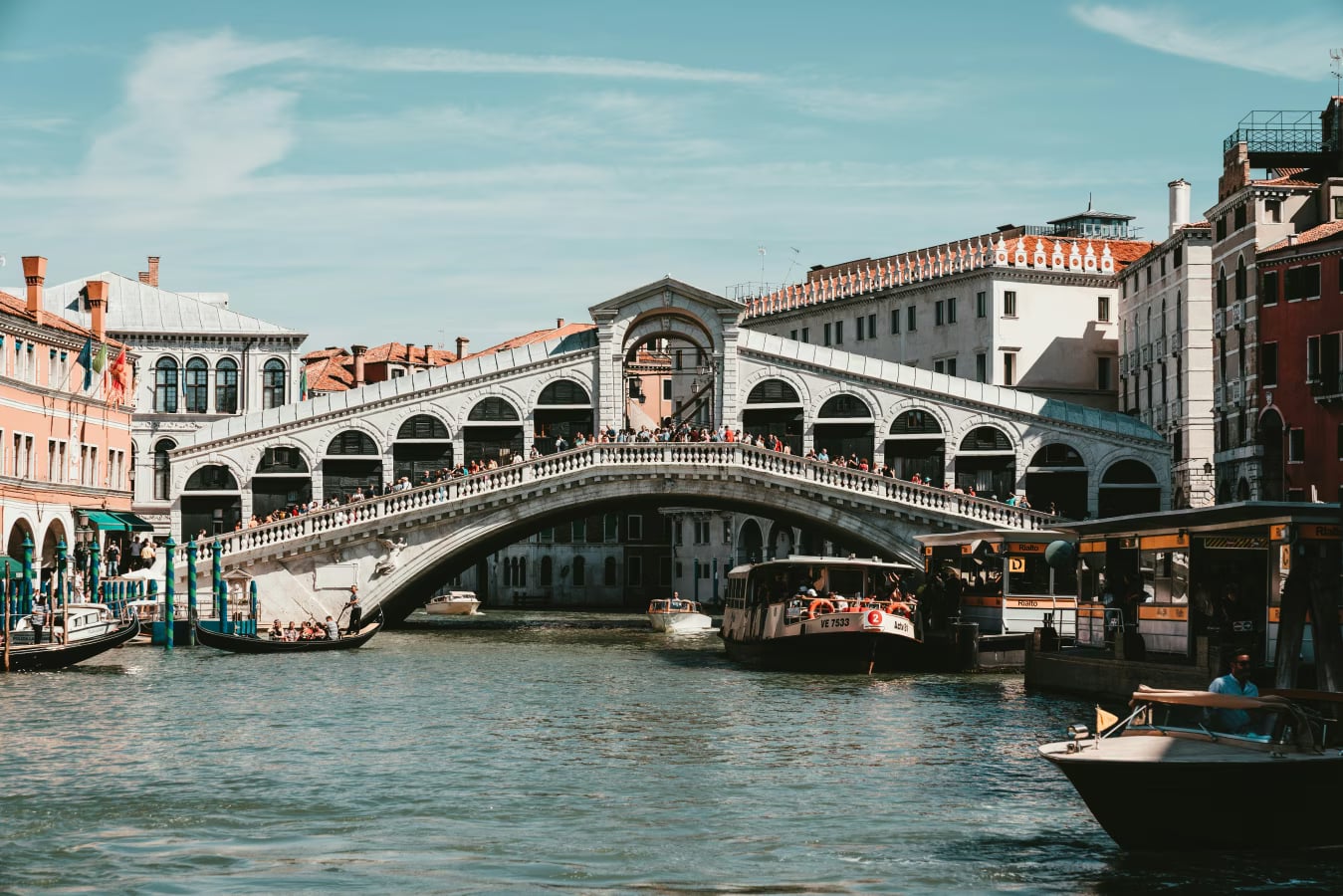
This mobile audio guide takes you from Rialto to Piazza San Marco. The app map helps with navigation, and audio can play automatically when GPS shows you have reached each stop. The walk starts on the famous 16th-century Rialto Bridge and follows the Grand Canal past historic palaces linked to Venice’s last Doge and Elena Cornaro Piscopia, some now used by Venice City Hall. It then cuts into small campos and lanes where monuments, old parish traces, and surprising details - like an embedded cannonball and a dragon-shaped lamp - bring the city’s stories to life. Near Teatro La Fenice and Teatro Goldoni, Venice’s theatre tradition appears alongside everyday street scenes. The route ends with the city’s greatest landmarks: the Clock Tower, St Mark’s Basilica with its golden mosaics and treasures, and the wide stage of Piazza San Marco and the Piazzetta by the Doge’s Palace and the column of Saint Mark.
- Duration
- 1h
- Distance
- 2.3 km
- Stops
- 19 locations
- Languages
- 9 languages


Updated 2026-01-18
Interactive Map
Tour Stops (19)
Stop 1: Ponte di Rialto (Rialto Bridge)
Venice’s iconic stone bridge over the Grand Canal, built in the 1500s - a historic crossing lined with shops and canal views.
Stop 2: Palazzo Dolfin Manin and Ponte Manin
A Renaissance palace tied to Venice’s last Doge, followed by a nearby bridge that links noble history with everyday street life.
Stop 3: Ca' Loredan (Corner Piscopia, Loredan)
A Grand Canal palace tied to Elena Cornaro Piscopia and today part of Venice’s City Hall offices, linked to nearby Ca’ Farsetti.
Stop 4: Ca' Farsetti (Palazzo Dandolo Farsetti)
A 13th-century Grand Canal palace near Rialto, shaped by the Dandolo, Contarini, and Farsetti families, and now part of Venice City Hall.
Stop 5: Campo Manin
A central Venetian campo with Daniele Manin’s 1875 monument and winged lion, recalling the 1848-49 fight for independence.
Stop 6: Campo Sant'Angelo and the former Church of Sant'Angelo
A quiet campo in San Marco named for a church demolished in 1837, surrounded by historic palaces and traces of Venice’s older parish life.
Stop 7: Chiesa di San Fantin and Teatro La Fenice
A medieval-rooted church beside Teatro La Fenice, Venice’s phoenix-like opera house rebuilt after major fires, including the arson blaze of 1996.
Stop 8: Ponte de Piscina (Ponte de la Piscina di Frezzaria)
A small bridge over Rio dei Barcaroli in San Marco, leading into Venice’s tight network of lanes toward Ramo del Salvadego.
Stop 9: Gondola Bacino Orseolo
A small basin behind Piazza San Marco, created in 1863 as a gondola landing and still one of Venice’s busiest gondola pickup spots.
Stop 10: Campo San Luca
A central Venetian campo near San Luca church and Teatro Goldoni - a key walking crossroads between St Mark’s and Rialto.
Stop 11: Teatro Goldoni
Venice’s historic Teatro di San Luca from 1622, later renamed Teatro Goldoni in 1875 - the city’s key stage for spoken theatre.
Stop 12: Campo San Salvador - Chiesa di San Salvador, the Cannonball, and the Marforio Dragon Lamp
A lively square near Rialto with Chiesa di San Salvador’s embedded 1849 cannonball and the quirky Marforio wrought-iron dragon lamp.
Stop 13: Ponte de le Acque and the view to Ponte dei Bareteri
A small bridge in San Marco over Rio dei Bareteri, surrounded by narrow lanes and the shaded Sotoportego de le Acque nearby.
Stop 14: Chiesa di San Zulian (San Giuliano)
A Mercerie church rebuilt in the 1500s, with Sansovino’s facade and Tommaso Rangone’s bronze statue above the entrance.
Stop 15: Piazzetta dei Leoncini
A quiet corner beside St Mark’s Basilica, famous for its two 1722 marble “little lions” and the nearby memorial to Daniele Manin.
Stop 16: Torre dell’Orologio (Clock Tower)
Venice’s iconic 15th-century clock tower on Piazza San Marco, with an astronomical Zodiac dial and the famous bronze “Moors” striking the bell.
Stop 17: Saint Mark's Basilica (Basilica di San Marco)
Venice’s most famous church - Byzantine domes, 8,000 m² of mosaics, the Pala d’Oro, and the Horses of Saint Mark.
Stop 18: Piazza San Marco (St Mark’s Square)
Venice’s main square - framed by the Procuratie, watched over by the Campanile and Clock Tower, and often called the “drawing room of Europe.”
Stop 19: Colonna di San Marco and Doge’s Palace (Palazzo Ducale)
Venice’s iconic Piazzetta column of Saint Mark beside the Gothic Doge’s Palace - the republic’s power center, shaped by centuries of politics and legend.
Tips & Recommendations
- Start early or later in the afternoon to avoid the densest crowds around Rialto and Piazza San Marco.
- Wear comfortable shoes - the route includes many bridges and uneven stone pavements.
- Bring a light layer: canals and open squares can feel cooler and windier, even on warm days.
- Dress modestly for churches (covered shoulders and knees are a safe choice), especially for the Basilica.
- If queues are long at St Mark’s Basilica or the Clock Tower, treat them as optional and keep walking - the audio guide still makes sense without going inside.
- Gondola prices can be high near St Mark’s; for a quieter experience, consider a gondola ride earlier in the route or slightly away from the main basin.
- Keep an eye on bags in the busiest areas, especially near Rialto and in Piazza San Marco.